
10 Common CV Mistakes That Prevent You From Getting a Job Interview 🚫
Discover the top 10 mistakes job seekers make in their CVs, why they affect your chances of getting an interview, and how to avoid them with practical steps and clear examples.
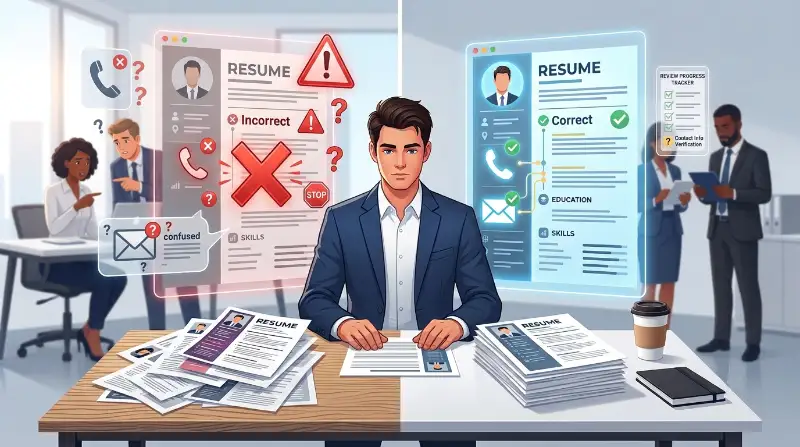
Is Your CV the Reason You're Not Getting Interviews? 🤔
You might have the perfect qualifications for the job, possess the required experience and skills, yet still not receive any interview invitations. If this has happened to you more than once, the problem likely isn't your experience—it's the CV you're submitting.
Your CV is the first thing a hiring manager sees, and it's the first impression that determines whether you'll advance to the next stage or have your application rejected. Even minor errors in writing or formatting your CV can reduce your chances of competing, even if you're fully qualified for the position.
In this guide, you'll discover the most 10 common mistakes that many job seekers make in their CVs, why these errors affect your interview chances, and most importantly, how to avoid them with practical steps and clear examples.
📌 Quick Summary
If you want to increase your CV's acceptance rate, make sure to:
- ✅ Proofread your CV linguistically before sending it.
- ✅ Use a simple and organized design that's easy to read.
- ✅ Write a career objective that reflects your experience and matches the job.
- ✅ Provide correct and up-to-date contact information.
- ✅ Focus on skills and experiences relevant to the job.
- ✅ Ensure your CV is compatible with ATS systems used by many companies.
📑 Article Contents
- Why Are Some CVs Rejected?
- Mistake #1: Spelling and Grammar Errors.
- Mistake #2: Cluttered or Disorganized Design.
- Mistake #3: Writing a Generic Career Objective.
- Mistake #4: Incorrect Contact Information.
- Mistake #5: Exaggerating Skills.
- Mistake #6: Unprofessional Presentation of Work Experience.
- Mistake #7: Using an Unprofessional Email Address.
- Mistake #8: Using an Outdated Template.
- Mistake #9: Not Customizing Your CV for Each Job.
- Mistake #10: Ignoring Applicant Tracking Systems (ATS).
- Pre-Submission CV Checklist.
- Frequently Asked Questions.
- Conclusion.
❓ Why Are Some CVs Rejected?
Many job seekers believe that getting an interview depends solely on years of experience or academic qualifications, but the reality is different. Before a hiring manager reads your experience details, they first look at how it's presented within your CV.
When your CV is organized, clear, and easy to read, it becomes easy for the hiring manager to find important information quickly. However, if it's full of errors, disorganized information, or confusing design, it may be rejected without a thorough review of its content.
That's why writing a professional CV isn't just about listing your personal information and work experience—it's also about presenting this information in a way that makes it compelling, easy to understand, and highlights your strengths from the very first moment.
❌ Mistake #1: Spelling and Grammar Errors
A spelling mistake might seem minor, but it's one of the errors that leaves a negative impression on hiring managers. Your CV represents your professional image, and any mistake in it may suggest a lack of attention to detail or failure to review content before submission.
This isn't limited to spelling errors alone—it also includes grammatical mistakes, punctuation errors, and incorrect word usage.
❌ Unprofessional Example:
"I worked as a sales manager for five years and was able to increase sales through new strategies and market analyze."
✅ Correct Example:
"I worked as a sales manager for five years and successfully increased sales through new strategies and continuous market analysis."
Notice how the second example is clearer, more professional, and reflects greater attention to content quality.
💡 How to Avoid This Mistake:
- Review your CV multiple times before sending it.
- Read the text aloud—this helps spot errors you might miss during quick reading.
- Use spell-check tools, but don't rely on them completely.
- Ask someone else to review your CV—they might notice errors you've overlooked.
❌ Mistake #2: Cluttered or Disorganized Design
Some job seekers believe that using many colors, icons, or different fonts makes their CV more attractive, but the truth is that excessive design can make the CV harder to read.
The goal of CV design isn't to grab attention with colors, but to organize information in a way that helps the hiring manager quickly find the most important data.
🚩 Signs That Your CV Design Needs Improvement:
- Using more than two font types.
- Relying on many contrasting colors.
- Writing long paragraphs without breaks.
- Insufficient spacing between sections.
- Using tables or elements that are hard to read.
- Inconsistent font sizes used randomly.
❌ Example of Poor Design: Four different font types, colored backgrounds, cramped text, unclear sections, excessive use of icons and graphics.
✅ Better Example: One or two fonts only, subtle and neutral colors, clear headings for each section, using bullet points instead of long paragraphs, appropriate spacing between sections.
❌ Mistake #3: Writing a Generic Career Objective
The career objective is the first paragraph a hiring manager reads after your name, so it should clearly convey your specialization, experience, and the value you can bring to the company.
However, many job seekers use generic phrases like: "I am looking for a job opportunity in a reputable company that helps me develop my skills." This statement doesn't distinguish you from other applicants and could apply to almost anyone.
❌ Unprofessional Example:
"I am looking for a suitable job that helps me develop my skills and gain new experiences."
✅ Correct Example:
"Digital Marketing Specialist with four years of experience in managing advertising campaigns and improving website visibility in search engines, seeking to leverage my expertise in developing marketing campaigns and achieving measurable results."
💡 How to Write a Strong Career Objective:
- Start with your specialization or job title.
- Mention years of experience if you have them.
- Highlight key skills or achievements.
- Keep the paragraph concise—no more than four lines.
❌ Mistake #4: Incorrect Contact Information
This might seem like a minor error, but it could cost you a job opportunity without you realizing why. Imagine a hiring manager likes your CV and wants to invite you for an interview, but they find an incorrect phone number, a non-working email, or no valid contact method at all.
📋 What Should Contact Information Include?
- Full name.
- Correct and up-to-date phone number.
- Professional email address.
- City or location of residence.
- LinkedIn profile link if updated.
- Portfolio link if your work requires it.
❌ Unprofessional Example: Name: Ahmed, Email: [email protected], Phone: 212222212 (without country code), No LinkedIn profile.
✅ Better Example: Ahmed Mohamed Ali, [email protected], +1111 11XXXXXXX, linkedin.com/in/ahmedali
❌ Mistake #5: Exaggerating Skills or Adding Skills You Don't Have
One of the most common mistakes job seekers make is trying to convince the hiring manager that they possess as many skills as possible, even if they don't have real experience with them.
This approach might temporarily attract attention, but it often becomes apparent during interviews or practical tests.
❌ Unprofessional Example: A list including: Programming, Design, Accounting, Marketing, Artificial Intelligence, Data Analysis, Project Management, Human Resources, Negotiation, Sales, Cybersecurity, App Development.
✅ Better Example: Core Skills: Managing Google Ads campaigns, SEO, Data Analysis using Google Analytics, Marketing Content Writing, Team Management.
💡 How to Choose the Right Skills? Read the job posting carefully and ask yourself: What skills are required? Which ones do I actually have? Can I prove them through my past experience?
❌ Mistake #6: Unprofessional Presentation of Work Experience
The work experience section is what hiring managers focus on most, as it shows what you've accomplished in previous roles—not just where you worked.
❌ Unprofessional Example: Sales Representative - ABC Company - 2022-2025: Selling products, communicating with customers, preparing reports.
✅ Better Example: Sales Representative - ABC Company - 2022-2025: Exceeded annual sales targets by 18%, acquired over 120 new clients within two years, improved customer retention rates by developing a periodic follow-up system, prepared weekly performance reports that helped management make better marketing decisions.
💡 How to Write Experience Professionally? For each role, try to answer: What did I accomplish? What results did I achieve? Are there numbers I can mention? How did I contribute to the company's success?
❌ Mistake #7: Using an Unprofessional Email Address
Some might think that an email address is a minor detail, but it's part of the professional image you present to the hiring manager.
❌ Examples of Unprofessional Email Addresses: [email protected], [email protected], [email protected]
✅ Examples of Professional Email Addresses: [email protected], [email protected]
❌ Mistake #8: Using an Outdated or Inappropriate CV Template
Choosing a CV template isn't just about appearance—it's an important factor that affects how the hiring manager reads your information.
🚩 Signs That Your Template Needs Changing: Too many colors, hard-to-read fonts, too many images or icons, complex tables, unnecessary sections taking up space, design that doesn't work well on mobile.
✅ Professional Template Features: Simple and organized, clear headings, easy-to-read font, highlights experience and achievements, comfortable white space, compatible with ATS systems.
❌ Mistake #9: Sending the Same CV to All Jobs
A common mistake is sending the same CV to dozens of different jobs without making any adjustments.
🎯 Why Should You Customize Your CV? Because each job posting contains specific keywords and skills that the employer is looking for.
💡 Steps to Customize Your CV: Read the job description carefully, identify keywords, adjust your career objective, prioritize skills based on relevance, highlight the most relevant experience.
❌ Mistake #10: Ignoring Applicant Tracking Systems (ATS)
In recent years, many companies have started using electronic systems to help organize and filter job applications, known as ATS (Applicant Tracking System).
🚩 Errors That Make Your CV Incompatible with ATS:
- Using images containing important information.
- Using complex tables.
- Using unclear headings.
- Not using relevant keywords.
💡 How to Make Your CV ATS-Compatible:
- Use a simple and organized design.
- Write information as clear text, not inside images.
- Use traditional section headings.
- Add relevant keywords from the job description.
- Save the file in the required format (PDF or Word).
✅ Pre-Submission CV Checklist
📋 Personal Information: Full name, Phone number, Email address, City, Professional account links.
📋 Content: No spelling errors, Appropriate career objective, Chronological experience, Achievements mentioned, Skills relevant to the job.
📋 Design: Easy to read, Clear fonts, Appropriate colors, No excessive elements, File opens correctly.
📋 ATS Compatibility: Clear headings, No important info inside images, Relevant keywords present, Simple formatting, File saved in required format.
❓ Frequently Asked Questions About CVs (FAQ)
What's the best CV format? Reverse-chronological format is most common, where you start with your most recent position and work backward.
Should I include a photo on my CV? It depends on the country and position. If you include one, make sure it's professional with a simple background.
What's the ideal CV length? Fresh graduates: one page, Mid-level professionals: one to two pages, Senior professionals: may be longer if relevant.
Which skills should I include? Skills directly related to the job, divided into technical skills and soft skills.
Should I include a career objective? Yes, provided it's written properly to show your specialization, experience, and value.
What is an ATS? A system companies use to organize and filter applications. To be compatible, use simple formatting and include relevant keywords.
🎯 Conclusion: Make Your CV Your First Key to Getting a Job Opportunity
Your CV isn't just a page containing your personal information and past experience—it's your primary tool for presenting yourself to employers. Therefore, how you write and organize it may be the deciding factor between getting an interview or having your application rejected.
In this article, we've covered the most common mistakes many job seekers make, such as spelling errors, inappropriate design, unclear information, not customizing the CV for each role, and ignoring the importance of ATS systems.
These mistakes might seem minor, but they directly affect the first impression you leave on the hiring manager. The good news is that improving your CV doesn't require complex steps—it starts with reviewing details, organizing information, and focusing on showcasing your skills and achievements professionally.
Before sending your CV to any job, make sure it:
- ✅ Clearly demonstrates your experience and skills.
- ✅ Is customized for the position you're applying for.
- ✅ Is free from spelling and formatting errors.
- ✅ Is easy to read and compatible with modern recruitment systems.
Remember that competition in the job market is greater than ever, and a professional CV gives you a better chance to stand out among applicants.
If you want to create a professional CV easily, using a CV builder tool helps you choose a suitable template, organize your CV sections, and present your experience in a modern way that increases your visibility to hiring managers.
Start today by reviewing your CV and improving it step by step—a simple adjustment might be the difference between a CV that's ignored and one that leads you to the interview you've been looking for. 💼✨